
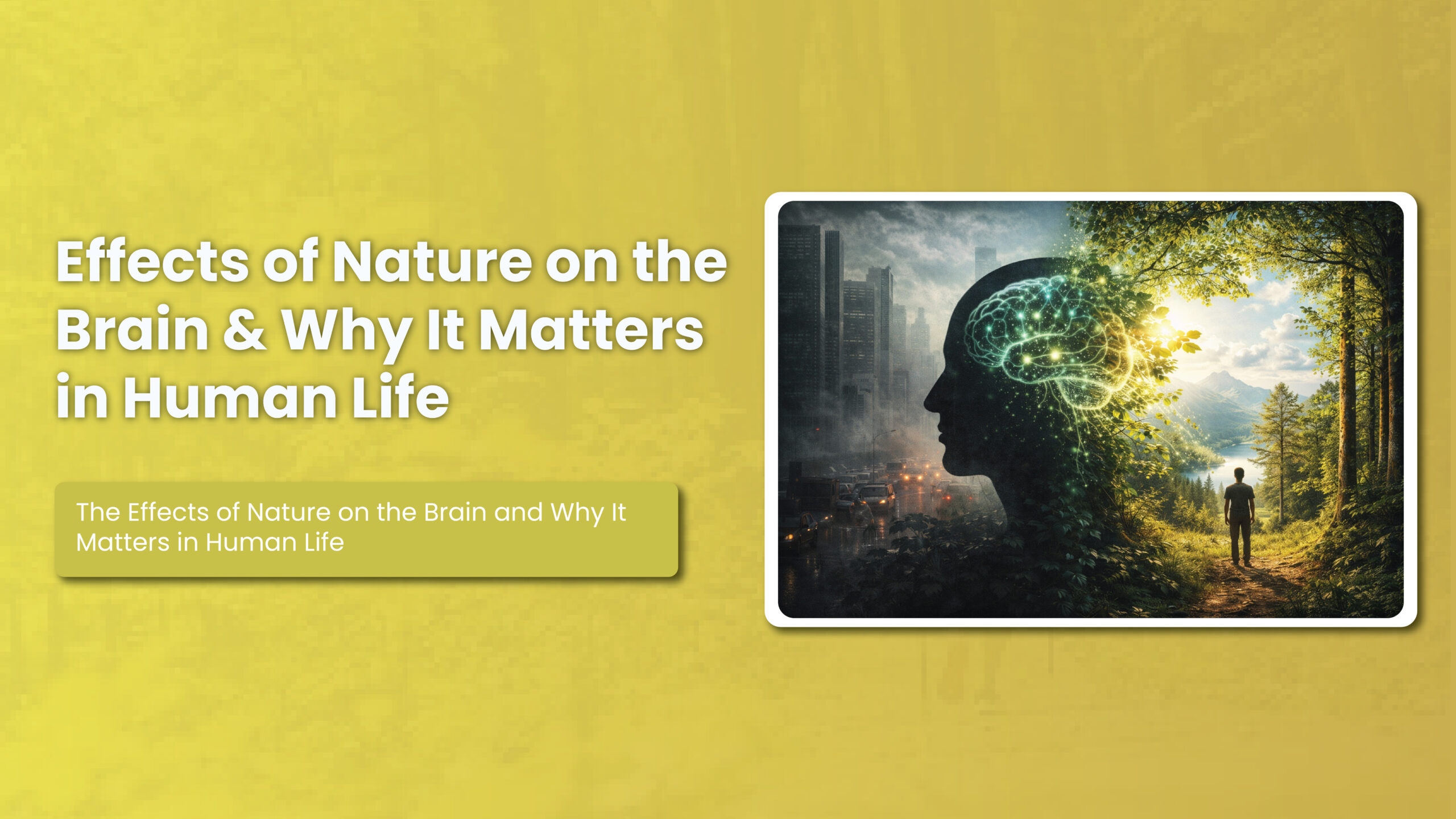
 The Effects of Nature on the Brain and Why It Matters in Human Life
In the modern world, the average human exists in a state of nearly constant stimulation. We are surrounded by concrete, illuminated by artificial blue light, and tethered to digital devices that demand our unceasing attention. While technology and urbanization have brought undeniable comforts and advancements, they have also introduced a new set of challenges for the human mind. Rates of anxiety, burnout, and depression are climbing globally. In looking for a cure, scientists and psychologists are increasingly turning their attention back to our origins. They are studying nature and the brain.
For centuries, poets and philosophers have argued that a walk in the woods is good for the soul. Today, neuroscience is proving that it is also essential for the mind. The relationship between nature and the brain is not merely poetic or sentimental. It is deeply biological. When we step away from the city and immerse ourselves in the natural world, profound physiological changes occur. These changes affect everything from our stress hormones to the way our neurons fire. Understanding the effects of nature on the brain is no longer just about enjoying a nice view. It is about understanding a critical component of mental health and cognitive longevity.
How does nature affect the brain?
To understand the impact of the outdoors, we first have to look at what happens inside the skull when we are stressed. In a high-pressure urban environment, the brain is often in a state of hyper-arousal. The amygdala, which is the part of the brain responsible for detecting threats and processing fear, stays active. It signals the release of cortisol and adrenaline. This is the ancient “fight or flight” mechanism. While this was useful for our ancestors when running from predators, it is damaging when triggered by traffic jams, email notifications, and crowded subways.So, how does nature affect the brain in this context? It acts as a direct antidote to this stress response. Research has shown that spending time in a forest environment, a practice known in Japan as Shinrin-yoku or “forest bathing,” significantly lowers cortisol levels compared to spending time in a city center.
When you enter a green space, your parasympathetic nervous system activates. This is often called the “rest and digest” system. Your heart rate slows down and your blood pressure drops. The amygdala quiets down. This shift allows the brain to divert energy away from survival mode and toward recovery and repair. This is not just a feeling of relaxation. It is a measurable biological shift that reduces the risk of stress-related illnesses.
The cognitive effects of nature on the brain
Beyond simple relaxation, nature has a powerful ability to restore our focus. This is best explained by a concept called Attention Restoration Theory (ART). In our daily lives, we rely heavily on what psychologists call “directed attention.” This is the kind of focus required to read a report, drive a car in heavy traffic, or debug code. Directed attention is a finite resource. When it is depleted, we experience “directed attention fatigue,” which leads to irritability, distraction, and poor decision-making.The effects of nature on the brain regarding focus are unique because nature engages a different type of attention. This is known as “soft fascination.” When you look at a sunset, the rustling leaves of a tree, or the motion of clouds, your attention is held, but it is not forced. You do not have to concentrate to watch a waterfall. This state of soft fascination allows the parts of the brain responsible for directed attention to rest and recharge.
Studies have demonstrated that even short bursts of nature exposure can improve cognitive performance. In one study, participants who took a walk in a park performed significantly better on memory and attention tests than participants who walked down a busy city street. This suggests that the role of nature in human life extends to our productivity and our ability to think clearly. By giving our cognitive faculties a break, nature enables us to return to our tasks with renewed sharpness.
Understanding nature’s effect on the brain and emotional regulation
One of the most profound discoveries in recent years concerns nature’s effect on the brain regarding emotional regulation and mental health disorders. A specific area of the brain called the subgenual prefrontal cortex is particularly interesting to researchers. This area is highly active during “rumination.” Rumination is the repetitive loop of negative thoughts that is often associated with depression and anxiety. It is the voice in your head that focuses on what went wrong yesterday or what might go wrong tomorrow.Research conducted at Stanford University found that participants who went for a 90-minute walk in a natural area showed decreased activity in the subgenual prefrontal cortex compared to those who walked in a high-traffic urban setting. The people who walked in nature also reported less rumination. They were physically less able to dwell on negative thoughts.
This suggests that the environment we inhabit acts as a regulator for our emotional state. In a sterile or chaotic environment, the brain creates its own noise in the form of worry. In a natural environment, the external world provides a soothing sensory input that quiets the internal noise. This highlights the importance of nature in human life as a buffer against the mental health crisis that plagues many developed nations.
The importance of nature in human life and physical health
While the brain is the control center, we cannot disconnect it from the body. The importance of nature in human life is also evident in how the environment affects our physical immunity, which in turn supports brain health.Plants and trees emit airborne chemicals called phytoncides. These are natural antimicrobial compounds that plants use to protect themselves from insects and rotting. When humans breathe in these chemicals, our bodies respond by increasing the number and activity of a type of white blood cell called a Natural Killer (NK) cell. These cells are vital for fighting tumors and virus-infected cells.
When the body is physically healthier and the immune system is robust, the brain is less inflamed. Chronic inflammation has been linked to depression and cognitive decline. Therefore, the fresh air of a forest is not just “fresh” in a metaphorical sense. It is chemically distinct from city air and provides biological resources that support the entire human system. This biological connection reinforces the fact that we are organisms evolved to live in nature, not apart from it.
The role of nature in human life and social connection
The benefits of nature ripple outward from the individual to the community. The role of nature in human life includes shaping how we treat one another. When the human brain is stressed and depleted, empathy is often the first thing to disappear. We become more aggressive, more withdrawn, and less trusting when we are suffering from cognitive fatigue.By restoring our mental resources and lowering our stress baselines, nature opens the door for better social interactions. Studies in public housing projects have shown that buildings surrounded by green space have lower crime rates and stronger ties between neighbors compared to identical buildings surrounded by concrete.
Furthermore, exposure to nature has been linked to increased generosity and benevolence. The awe we feel when looking at a vast ocean or a mountain range promotes a “pro-social” behavior. It makes us feel smaller in a positive way, shifting our focus from our individual ego to the collective group. This suggests that green spaces in cities are not just aesthetic decorations. They are vital infrastructure for maintaining a cohesive and peaceful society.
Integrating the role of nature in our life
Recognizing the science is the first step, but action is the second. We must actively prioritize the role of nature in our life. Many people believe they need to go on a week-long camping trip or move to the countryside to experience these benefits, but this is not true. The brain is responsive to even small doses of nature.Current research suggests that as little as 120 minutes of time in nature per week is associated with good health and well-being. This two-hour threshold does not have to be achieved all at once. A twenty-minute walk during a lunch break, a weekend visit to a local park, or spending time gardening in the backyard all count toward this total.
Even “micro-doses” of nature can help. If you cannot get outside, bringing nature inside is a viable strategy. House plants, views of trees from a window, or even nature documentaries have been shown to lower heart rates and improve mood, albeit to a lesser degree than full immersion. The goal is to reduce the sensory overload of the artificial world and reintroduce the organic patterns, sounds, and smells that our brains evolved to process.
Conclusion
We often view nature as a luxury. We see it as a place to visit on vacation or a backdrop for recreation. However, the neuroscience is clear. Nature is not a luxury. It is a fundamental requirement for a healthy human mind. From dampening the stress response of the amygdala to quieting the ruminating thoughts of the prefrontal cortex, the outdoors provides a necessary reset for our biological systems.The evidence overwhelming points to the importance of nature in human life. As we continue to build cities and develop technologies that pull us further away from the physical world, we must be conscious of the toll this takes on our psychology. We have ancient brains living in a modern world. To thrive, we must bridge that gap by stepping away from the screen, walking out the door, and reconnecting with the environment that built us. By prioritizing nature, we are not just saving the planet; we are saving our own minds.


