Table of Contents:
- Introduction
- Understanding Smart Home Care
- Major Technologies Transforming Home Care
- Benefits of Smart Home Care Technology
- Role of Wearable Health Devices
- AI and Data Analytics in Future Healthcare
- Challenges Facing Smart Home Healthcare
- Future Trends in Home Healthcare Technology
- Expert Tips for Adopting Smart Home Care
- Conclusion
Introduction:
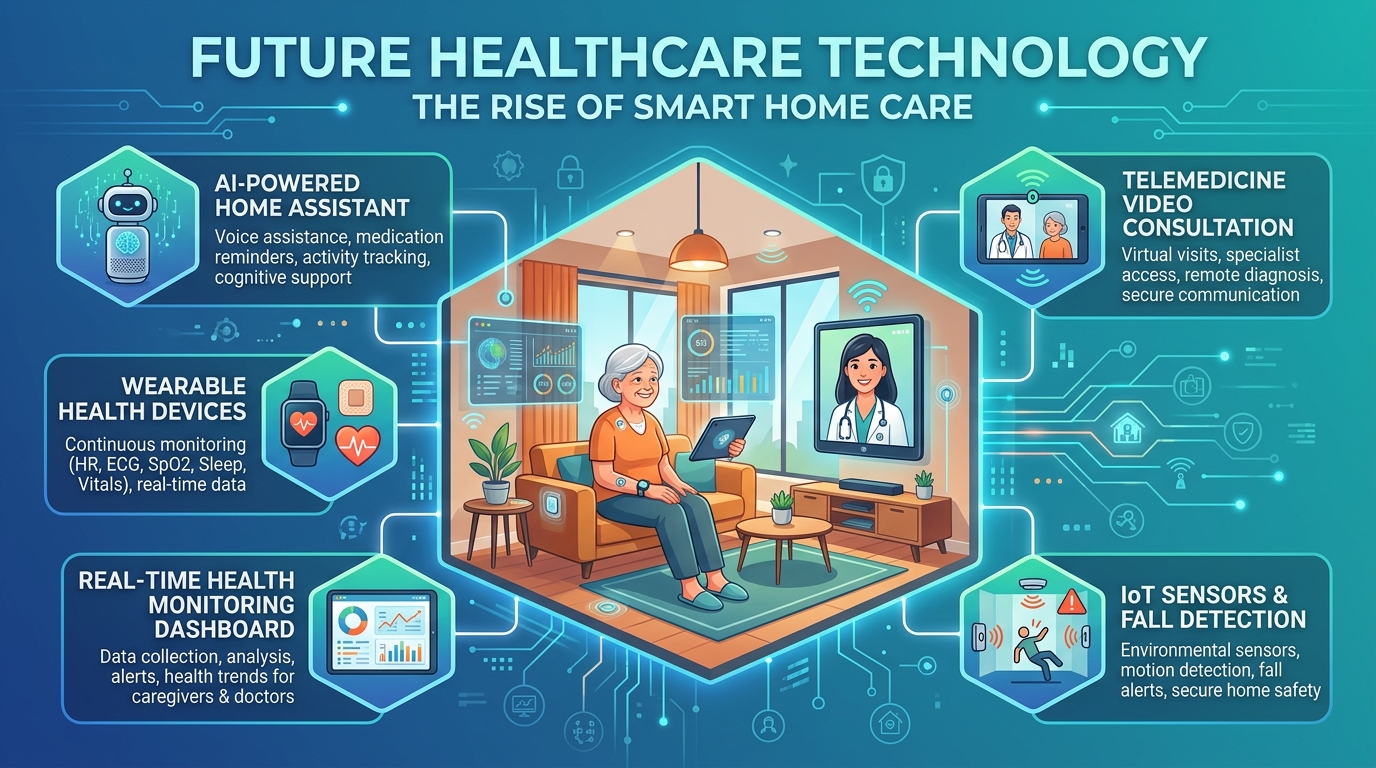
Future healthcare technology is rapidly changing how medical services are delivered around the world. Modern innovations are making healthcare more accessible, efficient, and personalized for patients of all ages. One of the biggest advancements in recent years is the rise of smart home care solutions. These technologies allow patients to receive medical support and monitoring from the comfort of their homes without frequent hospital visits.
The demand for smart home care continues to grow because people want convenient and affordable healthcare options. Elderly individuals, disabled patients, and people living in remote areas especially benefit from these advanced systems. Technology now plays a major role in improving patient care, communication, and health monitoring.
This article explores how future healthcare technology is transforming smart home care, the major technologies involved, their benefits, challenges, and future trends shaping the healthcare industry.
Understanding Smart Home Care
:

Smart home healthcare refers to the use of digital technology and connected devices to provide medical support at home. These systems help doctors, caregivers, and patients monitor health conditions in real time through internet connected devices and software applications.
Traditional healthcare systems mainly depend on hospital visits and in-person consultations. In contrast, smart healthcare systems focus on remote monitoring, virtual communication, and automated health tracking. Patients can now manage chronic illnesses, track vital signs, and communicate with doctors without leaving their homes.
Receiving healthcare at home offers many advantages. Patients feel more comfortable in familiar surroundings, experience lower stress levels, and often recover faster. Home care solutions also reduce transportation difficulties and improve convenience for families.
Major Technologies Transforming Home Care
:

Artificial Intelligence in Healthcare
:
Artificial Intelligence, commonly known as AI, is becoming one of the most important technologies in healthcare. AI powered systems can monitor patient health, analyze symptoms, and provide early warnings for potential medical issues.
Virtual health assistants help patients schedule medications, track symptoms, and answer health related questions. AI can also support predictive healthcare solutions by identifying disease risks before symptoms become severe.
Internet of Things Devices :
Internet of Things technology connects healthcare devices through the internet to share real time information. Smart wearable devices such as fitness bands and smartwatches can monitor heart rate, oxygen levels, sleep quality, and physical activity.
Remote patient monitoring systems allow healthcare professionals to track patient conditions continuously from distant locations. Connected healthcare equipment improves communication between doctors and patients while reducing emergency risks.
Telemedicine and Virtual Consultations :
Telemedicine has become highly popular because it allows patients to consult doctors online through video calls and digital platforms. Virtual healthcare services reduce waiting times and improve healthcare access for people living far from medical facilities.
Digital communication tools help patients share medical reports, receive prescriptions, and discuss treatment plans remotely. This technology became especially important during global health emergencies when physical visits were limited.
Robotics and Automation :
Telemedicine has become highly popular because it allows patients to consult doctors online through video calls and digital platforms. Virtual healthcare services reduce waiting times and improve healthcare access for people living far from medical facilities.
Digital communication tools help patients share medical reports, receive prescriptions, and discuss treatment plans remotely. This technology became especially important during global health emergencies when physical visits were limited.
Benefits of Smart Home Care Technology
:

Smart home care technology provides several important benefits for patients and healthcare providers. One major advantage is improved comfort and convenience because patients receive care in their own homes. Continuous monitoring also allows doctors to respond faster to medical emergencies or unusual health conditions.
Smart healthcare systems reduce unnecessary hospital visits and lower healthcare expenses for families. Elderly and disabled individuals receive better support through personalized care technologies that improve their daily quality of life.
Another major benefit is increased healthcare accessibility in remote or underserved areas. Patients living far from hospitals can still communicate with medical professionals through digital healthcare platforms.
Role of Wearable Health Devices :

Wearable health devices are becoming essential tools in modern healthcare. Smartwatches and fitness trackers help users monitor important health data such as heart rate, exercise levels, sleep quality, and stress management.
Advanced wearable devices can also monitor blood pressure, glucose levels, and oxygen saturation in real time. These technologies help patients and doctors detect health changes early and prevent serious complications.
Real time data collection improves healthcare decision making because doctors receive accurate information about patient conditions outside clinical environments.
AI and Data Analytics in Future Healthcare :

AI and data analytics are transforming healthcare into a more personalized system. Healthcare technologies now analyze large amounts of medical information to provide customized treatment recommendations for individual patients.
Artificial Intelligence can detect diseases earlier by identifying hidden patterns in patient data. Predictive analytics also helps doctors estimate future health risks and create preventive treatment plans.
Data driven healthcare decisions improve efficiency, reduce medical errors, and support better patient outcomes. These technologies continue to shape the future of healthcare innovation worldwide.
Challenges Facing Smart Home Healthcare :

Despite its advantages, smart home healthcare also faces several challenges. Privacy and data security concerns remain major issues because healthcare systems store sensitive personal information online.
Advanced healthcare technologies can also be expensive for some families, especially in developing regions. Internet connectivity limitations may affect the reliability of remote healthcare services in rural areas.
Another challenge is the lack of digital healthcare education. Some patients and elderly individuals may struggle to use modern healthcare devices and applications effectively.
Future Trends in Home Healthcare Technology :

The future of smart home care looks highly advanced and innovative. AI powered smart homes may soon provide automated healthcare support based on real time patient needs. Remote surgeries and advanced telehealth systems could allow specialists to assist patients globally.
Voice controlled healthcare assistants will likely become more common for medication reminders and emergency communication. Virtual reality technology may also improve rehabilitation and mental health treatments from home.
The expansion of connected healthcare ecosystems will continue improving communication between patients, doctors, caregivers, and healthcare facilities.
Expert Tips for Adopting Smart Home Care :

Patients should carefully choose reliable healthcare devices from trusted manufacturers. Strong cybersecurity protection is important for protecting personal medical information from online threats.
Healthcare professionals should always be consulted before using advanced medical technologies at home. Regular software updates and device maintenance are also necessary for safe and effective healthcare monitoring.
Families should learn basic digital healthcare skills to improve their understanding of smart healthcare systems and devices.
Conclusion :
Future healthcare technology is transforming how people receive medical care at home. Smart home care solutions improve convenience, accessibility, and healthcare efficiency for patients worldwide. Technologies such as Artificial Intelligence, wearable devices, telemedicine, and automation continue to shape the future of healthcare services.