Table of Content:
- Introduction
- What Does Colour Changing Nail Technology Actually Mean
- Core Technology Behind Instant Colour Change
- Role of Microelectronics in Smart Nails
- How the Colour Change Process Works in Practice
- Why Press-On Nails Are Used Instead of Liquid Polish
- Limitations and Technical Challenges
- Comparison with Traditional Colour Changing Methods
- Future Developments in Smart Nail Technology
- Market Impact and Industry Direction
- Final Perspective
Introduction:
The idea of nail colour changing instantly sounds futuristic, yet current innovations show it is becoming practical and commercially viable. Traditional nail polish requires removal and reapplication for any change, which takes time and effort. In contrast, modern smart nail systems use advanced materials and controlled electrical signals to alter colour on demand. This shift is not just cosmetic innovation, it reflects a broader trend where beauty merges with wearable technology. Understanding how this works requires exploring materials science, microelectronics, and user interaction design working together.
What Does Colour Changing Nail Technology Actually Mean?

Colour changing nail systems do not behave like standard polish applied with a brush. Instead, they rely on engineered layers embedded inside a press-on or structured nail surface. These layers respond to electrical stimulation or environmental changes, which allows colour to shift without removing the product. Most current solutions use press-on nails rather than liquid polish because hardware integration is required. This means the nail itself becomes a controlled surface rather than a passive coating.
From a functional perspective, the nail acts like a small display that holds and changes colour states. The system does not continuously consume power once the colour is set, which improves usability. This is similar to how e-readers display text without constant energy consumption. The result is a reusable visual surface that updates when triggered rather than continuously operating.
Core Technology Behind Instant Colour Change:

The most credible and widely discussed approach uses electrochromic or electrophoretic materials. These materials change colour when an electrical voltage is applied across them. The process involves charged particles or pigments moving within a medium to create visible colour differences. Once the particles settle into position, the colour remains stable until another signal changes it again.
This technology is already used in products like e-ink displays and smart glass panels. When adapted for nails, the same principle allows multiple colours to be displayed using controlled electrical inputs. The advantage is efficiency, since energy is only required during the transition phase. This makes the system practical for small, portable applications like wearable beauty products.
Another important aspect is layering. Each nail contains multiple thin layers that control colour output, light reflection, and durability. These layers must be flexible enough for comfort but strong enough to withstand daily use. Achieving this balance requires precise material engineering and manufacturing control.
Role of Microelectronics in Smart Nails:

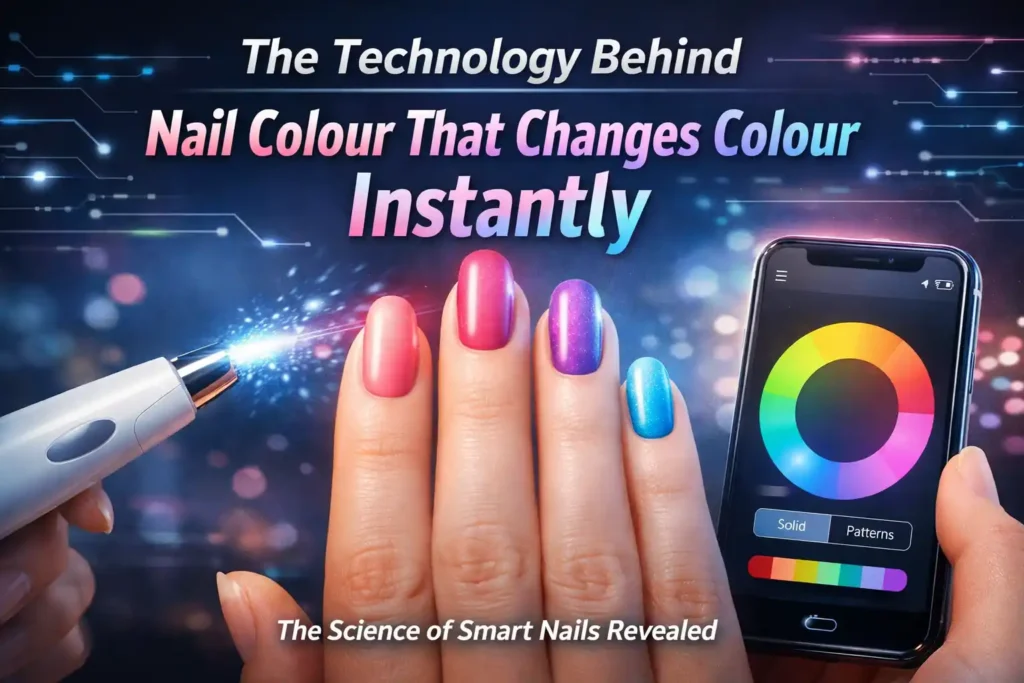
Microelectronics play a central role in enabling colour transitions. Each nail integrates conductive pathways that allow electrical signals to reach the active material layer. These pathways are extremely thin and embedded within the nail structure to remain invisible and unobtrusive. The system connects to an external device, often called a wand or controller, which delivers the required electrical input.
The controller acts as the interface between the user and the nail system. It translates user commands into specific electrical signals that trigger colour changes. This process must be precise because different voltages or durations produce different colours. The challenge lies in maintaining consistent results across all nails while ensuring safety and reliability.
In more advanced concepts, wireless communication may replace physical contact devices. However, this requires further miniaturisation and power optimisation before becoming widely available. Current solutions focus on simplicity and reliability rather than complex connectivity.
How the Colour Change Process Works in Practice?

The colour change process begins when the user selects a desired shade through an application or control interface. The system then calculates the required electrical parameters to achieve that colour. These parameters are sent to the nail through the controller, which applies a controlled voltage across the electrochromic layer.
Inside the nail, charged particles rearrange themselves based on the applied electrical field. This rearrangement changes how light is reflected or absorbed, which creates the visible colour shift. The process typically takes a few seconds per nail, depending on the system design and material response speed.
Once the particles settle into their new configuration, the colour remains stable without further energy input. This is a key advantage over LED based systems, which would require continuous power to maintain a colour. The stability also ensures that the nails remain visually consistent throughout normal daily activities.
Why Press-On Nails Are Used Instead of Liquid Polish?

Current technology cannot be applied directly as a liquid polish because it requires embedded electronic components. Press-on nails provide a stable structure where materials and circuits can be integrated without compromising functionality. This approach also allows manufacturers to standardise production and maintain quality control.
Press-on formats offer additional benefits such as ease of application and removal. Users can apply the nails without specialised tools, which makes the product accessible to a wider audience. However, this also introduces limitations in terms of shape customisation and long term reuse.
The structure of the nail must remain intact for the technology to function correctly. Cutting or reshaping the nail can damage internal layers, which affects performance. This is a trade-off between technological capability and user flexibility that manufacturers continue to refine.
Limitations and Technical Challenges:

Despite its innovation, colour changing nail technology faces several practical limitations. One major challenge is durability, as the nails must withstand physical impact, moisture exposure, and repeated handling. Maintaining performance under these conditions requires robust materials and protective coatings.
Another limitation is the need for individual nail updates in many current systems. Each nail may require separate activation, which adds time to the process. While this is still faster than traditional repainting, it reduces the sense of instant transformation.
Battery and power management also remain critical considerations. Although energy consumption is low, the system still depends on an external power source for updates. Future developments may integrate smaller power solutions directly into the nails, but this requires further advancement in battery technology.
Comparison with Traditional Colour Changing Methods:

Traditional colour changing nail products rely on temperature sensitive or UV reactive pigments. These materials change colour based on environmental conditions rather than user control. While they offer interesting effects, they lack precision and consistency.
Smart nail systems provide controlled colour changes that respond directly to user input. This allows for intentional styling rather than reactive behaviour. The difference is similar to comparing automatic sensors with manual controls, where the latter offers greater flexibility and predictability.
However, traditional methods remain more accessible due to lower cost and simplicity. Smart nails introduce higher complexity and price points, which may limit adoption in the early stages. Over time, scaling production and improving efficiency can reduce these barriers.
Future Developments in Smart Nail Technology:

The future of colour changing nail technology is closely linked to advancements in wearable electronics. As components become smaller and more efficient, integration will improve significantly. This could lead to fully wireless systems that update colours without external devices.
Another potential development involves dynamic patterns and animations rather than static colours. This would require more advanced display technologies and continuous power solutions. While technically feasible, it introduces additional challenges in terms of battery life and heat management.
Material innovation will also play a key role in improving flexibility and durability. New compounds could allow nails to be reshaped without damaging internal components. This would address one of the main limitations of current designs and expand usability.
Market Impact and Industry Direction:

Colour changing nail technology represents a shift toward programmable beauty products. Instead of fixed designs, users gain the ability to modify their appearance instantly. This aligns with broader trends in personalisation and digital control across multiple industries.
The beauty industry is likely to adopt hybrid models that combine traditional techniques with smart features. For example, decorative elements could be layered over colour changing surfaces to create more complex designs. This approach bridges the gap between innovation and established practices.
From a business perspective, the technology opens opportunities for recurring revenue models. Users may purchase new nail sets or digital design updates regularly. This creates a continuous engagement cycle rather than a one time purchase experience.
Final Perspective:
The technology behind nail colour that changes instantly is grounded in proven scientific principles adapted for a new application. Electrochromic materials, microelectronics, and structured design work together to create a functional and user controlled system. While still evolving, the concept demonstrates how beauty products can transition into interactive devices.
Adoption will depend on improvements in durability, cost, and ease of use. As these factors improve, the technology has the potential to move from novelty to mainstream acceptance. For now, it represents an early but meaningful step toward integrating digital control into everyday personal care products.
You May Also Like: